
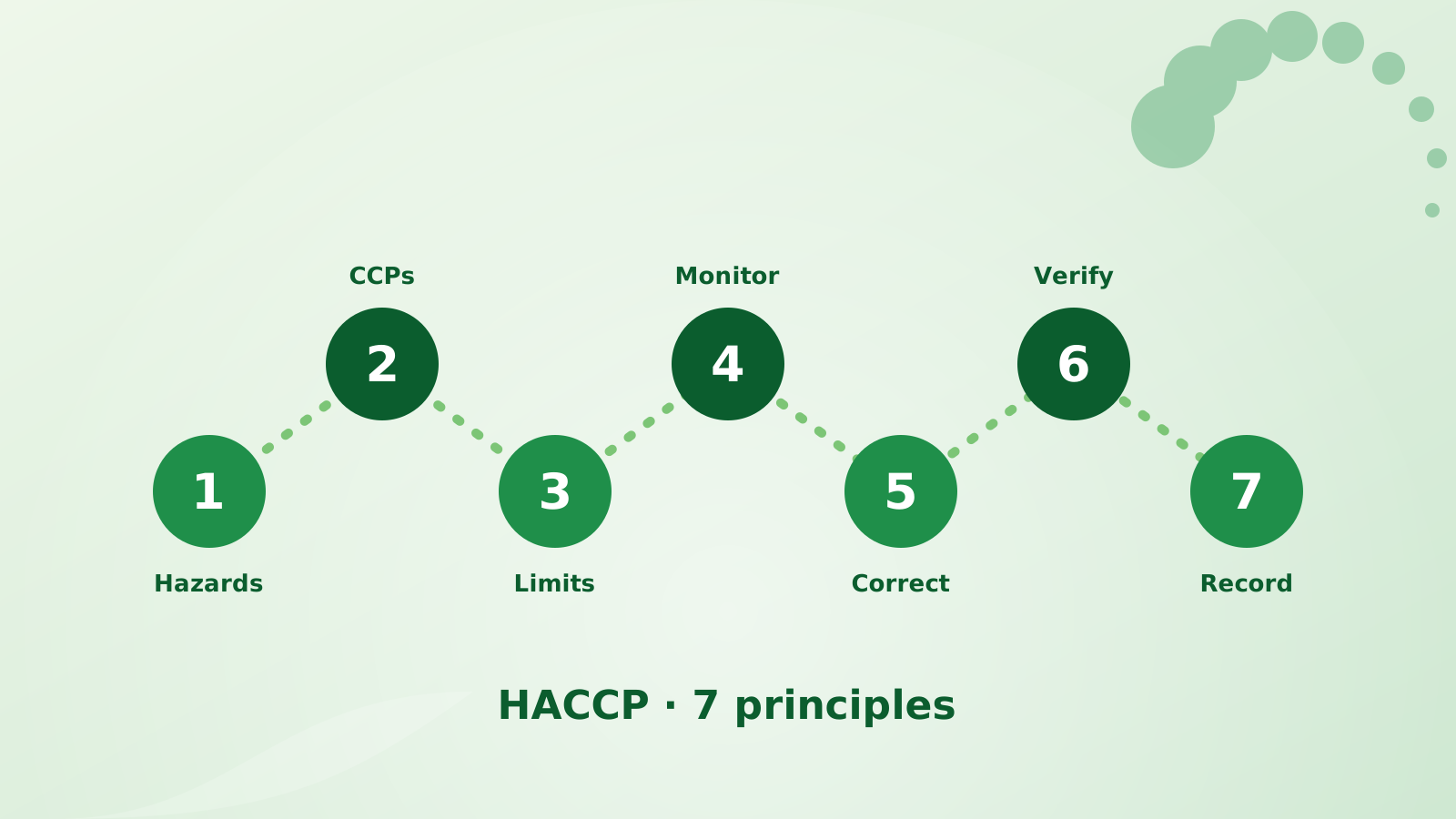
HACCP is a way of thinking before you act: find what could make food unsafe, decide where you can control it, and prove that you did. The Codex Alimentarius sets out seven principles.
The seven principles
- Conduct a hazard analysis. List the biological, chemical, physical and allergen hazards at each step.
- Determine the critical control points (CCPs). The steps where control is essential, such as cooking or metal detection.
- Establish critical limits. Measurable boundaries, for example a core temperature of 75 °C.
- Establish monitoring. Who checks, how, and how often.
- Establish corrective actions. What happens to the product and the process when a limit is missed.
- Establish verification. Calibrations, reviews and audits that confirm the plan works.
- Establish documentation and records. Evidence that every step was carried out.
Prerequisites come first
A HACCP plan sits on top of good hygiene practice: cleaning, pest control, maintenance, personal hygiene and supplier control. Without these, the plan has too many hazards to control.
Common mistakes
- Copying a plan from another business instead of walking your own process.
- Choosing too many CCPs, so monitoring becomes paperwork nobody trusts.
- Records filled in at the end of the day from memory.